
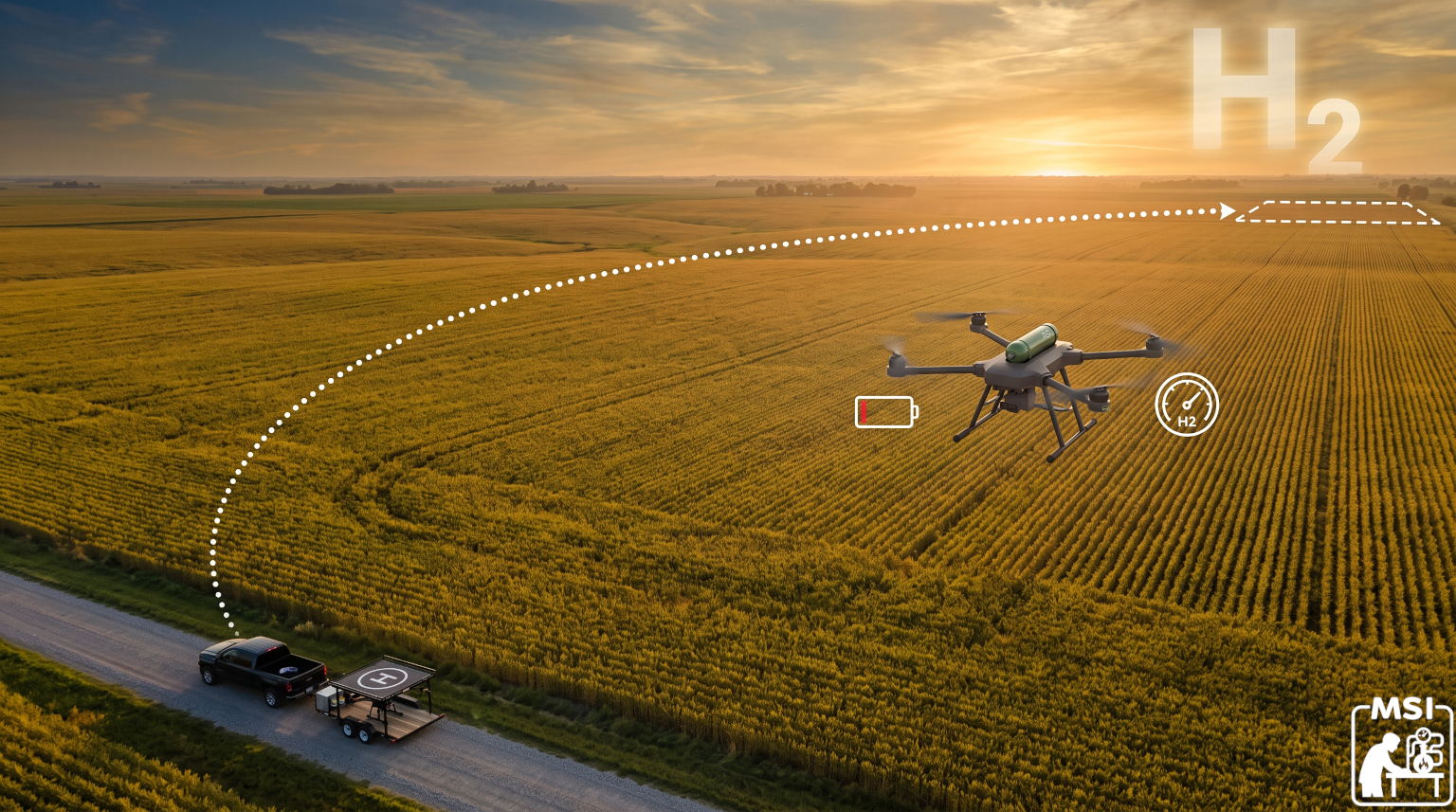
Key Takeaways
- Flight time is a major limitation for battery drones, averaging around 10 minutes per load.
- Hydrogen systems provide greater energy density compared to batteries, allowing for longer flight durations.
- A hybrid setup combining a battery for power and a hydrogen fuel cell for endurance could significantly extend flight times.
- Challenges like power demands, tank weight, and FAA approval hinder the development of hydrogen drones.
- Hydrogen could enhance operational efficiency, leading to quieter operations and better battery longevity.
It is obvious to any pilot of a large ag drone: its weakest point is flight duration. This is a complicated result of challenging aerodynamics, heavy payload, and battery technology. I am personally paranoid about a drone dropping into the crop because the battery is depleted. Worse, many of my fields require an extended ferry to reach all corners.
There has to be a better way!
How my spray drone is powered
My spray drone runs on a lithium battery pack. Each pack holds 2,025 watt-hours and weighs 32 pounds. I rotate three of them. One flies while the others cool and charge.
A full-load flight lasts about 10 minutes, and that is generous.
Charging happens in the field, off a generator. That leaves me two choices. A quiet generator is expensive to buy and expensive to fuel (diesel). A moderately priced gas generator is very loud. Add a second drone and I may need a second generator.
Why are flights so short? The drone lifts its own weight, its battery, and a tank full of liquid, and it does all of it with spinning propellers. Hovering is expensive. A bigger battery would last longer, but it adds weight, and the drone spends more energy carrying it. It is like packing a heavier lunch for a longer hike. You last longer, but every step costs more.
The packs also wear out. Makers rate them anywhere from a few hundred to about a thousand charge cycles, depending on how hard they work. Spraying works them hard.
So, every flight is a budget. Spray time, ferry time, and a safe reserve all come out of the same 10 minutes.
What if a tank of very light fuel could replace the heavy battery?
How a hydrogen drone works
A fuel cell is a strange little machine. It takes hydrogen from a tank and oxygen from the air, and it makes electricity. The exhaust is water. There is no fire and no moving parts.
Think of it as a battery that never runs down, as long as you keep feeding it.
This changes how energy is stored. In a battery drone, the energy and the power plant are the same heavy box. Adding more power means adding more weight. In a hydrogen drone, they split apart. The fuel cell makes the power. The tank holds the energy. A bigger tank means a longer flight, without a heavier power plant.
This is not a pipe dream: Real products exist today. Intelligent Energy, a British company, builds a 2,400-watt fuel cell module for drones. It weighs about 10.6 pounds. It runs on hydrogen stored at 5,000 psi and refuels in under three minutes. The company claims more than three times the flight time of batteries.
There is a catch that impacts drone design. A fuel cell likes a steady load. It does not like sudden demands for a lot of power. So, most designs pair the fuel cell with a small battery. The battery handles the spikes. The fuel cell handles the long, steady work.
I compared the energy of hydrogen to other fuels in Why Not Hydrogen? The short version: pound for pound, hydrogen carries far more energy than a battery.
The numbers, side by side
Two measures matter here, and they are easy to mix up.
Energy density is how much work you can carry per pound. It decides how long you can fly.
Power density is how hard you can push per pound. It decides how much weight you can lift right now.
Think of a sprinter and a marathon runner. The sprinter has enormous power for a short burst. The marathoner has less power, but keeps going for hours. A spray drone needs both. Lifting a full tank off the ground is a sprint. Ferrying home empty is a long walk.
I gathered the published numbers for the batteries in five spray drones, including my own.
| Drone battery | Pack weight | Energy density | Power density |
|---|---|---|---|
| Revolution I-19 | 32 lb | 63 Wh/lb | not published |
| DJI Agras T100 | 32.4 lb | 66 Wh/lb | 940 W/lb |
| XAG P100 Pro (2 packs) | 29.5 lb | 65 Wh/lb | 650 W/lb |
| Hylio AG-272 (2 packs) | 59.8 lb | 73 Wh/lb | 545 W/lb |
| EAVision J150 | 39.2 lb | 69 Wh/lb | 750 W/lb |
The batteries agree with each other remarkably well. Every pack stores about 63 to 73 watt-hours per pound. And every pack delivers a lot of power per pound, 545 to 940 watts, while hovering with a full tank. Batteries are sprinters.
Then I gathered the numbers for fuel cells built for drones.
| Fuel cell | Energy density (whole system) | Power density |
|---|---|---|
| H3 Dynamics A2000 | not published | 300 W/lb |
| Intelligent Energy IE-SOAR 2.4 | 270 to 360 Wh/lb (maker’s claim) | 225 W/lb |
| Doosan DP30M2S with 10.8 L tank | about 155 Wh/lb (my estimate*) | 180 W/lb |
| H3 Dynamics AEROPAK-800 pod | about 151 Wh/lb (includes motor and propeller) | n/a |
| Spectronik Protium-3000 | not published | 136 W/lb |
| Hydrogen fuel alone (50% efficient fuel cell) | 7,600 Wh/lb | n/a |
*Doosan publishes the powerpack and tank weight, 28 pounds together, and says the 10.8-liter tank holds about 260 grams of hydrogen. It does not publish the fuel cell’s efficiency, so I assumed 50%, the same figure I used in Why Not Hydrogen? The AEROPAK figure comes from H3’s own rating: 520 watts for an estimated five hours.

The picture flips. Whole-system energy figures are rare. One maker claims 270 to 360 watt-hours per pound. Two systems I could work out from published specs come in around 150 to 155. That is roughly 2 to 5 times what a battery carries. Hydrogen is the marathoner.
The size of the tank matters, too. A bigger tank adds hydrogen faster than it adds weight, so a hydrogen system gets better the longer the mission. A battery never does. Double the battery, and you double the weight.
But the power numbers run the other way. The best fuel cell I found makes about 300 watts per pound. A battery pack delivers 2 to 4 times that.
You may notice the hydrogen fuel itself carries about 7,600 watt-hours per pound, far more than the whole system. The difference is the bottle. Hydrogen is light, but holding it takes a heavy tank rated to 5,000 psi. The tank and the fuel cell eat most of the advantage. That is the honest number to remember: about 2 to 5 times a battery, not a hundred.
A fair comparison
Energy on paper is not flight time. A fair comparison has to carry the whole hydrogen system: the tanks, the fuel cells, and a battery for the spikes. So I sketched a hydrogen hybrid built to do the same job as my battery drone.
Both carry a 20-gallon spray tank. The battery drone’s numbers come straight from the maker’s manual: 16 minutes of hover with an empty tank, and 6 minutes at max load. The H2 Hybrid is my estimate. It carries a half-size battery sized to provide sprint-power for take-offs and to get the drone to the ground in case of emergency, about 92 pounds of fuel cells, and two hydrogen tanks holding about 520 grams of hydrogen. It is heavier, about 425 pounds at takeoff, so it needs larger props and larger motors.

By my estimate, the H2 Hybrid hovers about 19 minutes with a full tank, and about 37 minutes empty. That is roughly three times the battery drone at full load.
An known: I assumed the fuel cells turn half of the hydrogen’s energy into electricity. I am unsure about the actual fuel cell efficiencies, and I won’t know for certain until I perform testing. I also counted the bigger frame, motors, and props at the battery drone’s weight. That flatters the hybrid.
So neither one wins alone.
If a battery handles the sprint, lifting the full tank and spraying, and hydrogen handles the marathon, the ferry legs and the reserve, then each does what it does best. That is the case for a hybrid drone.
Two ways to build a hybrid
As I think it through, I see two ways to pair a battery with a fuel cell.
Side by side. The battery and the fuel cell share the load. The battery handles the big draws, like takeoff and lifting a full tank. The fuel cell carries the steady work in between, and sends any extra power back into the battery. Engineers call this a parallel hybrid. The sprinter and the marathoner run together, and each takes the stretch that suits them.
Fuel cell behind the battery. The fuel cell never touches the motors. It only charges the battery, all the time, while the battery runs the drone. This is a series hybrid, often called a range extender. Picture a rain barrel with a hose running into it while you draw water from the tap. The barrel does the work. The hose just keeps it from running dry.

Each has a tradeoff. The series design is simpler, and a fuel cell likes running at one steady output. But every watt goes into the battery and back out again, and each trip loses a little energy as heat. The battery also still has to be big enough to lift the full load on its own.
The parallel design sends most of the fuel cell’s power straight to the motors, so less is wasted. The battery only works during the peaks, which should be easier on it. The cost is smarter electronics to decide who supplies what, and when.
Either way, the same rule holds. The battery is sized for the peak and a 2–3-minute reserve. The fuel cell is sized for the steady work. In my estimate above, I took the cautious path and sized the fuel cells to carry a full-tank hover on their own. A smaller fuel cell, with the battery doing more of the lifting, may do better. That is one more thing testing will tell me.
I believe the parallel design fits my work better. It protects the battery and wastes less hydrogen. But that is a judgment, not a tested result.
So why isn’t every spray drone flying on hydrogen?
What hydrogen could do for me
Start with the problem I care about most: the ferry.
Longer legs. Many of my fields need a long flight just to reach the far corners. On one field, the farthest corner sits about three-quarters of a mile from where I can park. See the blue flight legs, below.

At 30 miles per hour, that is a minute and a half out and a minute and a half back. On a 10-minute flight, nearly a third of the battery goes to travel. In a hybrid drone, the fuel cell could carry those long, light legs. The battery would be saved for the heavy work. If that works, the reach from each tender stop grows, and I move the truck less.
A bigger reserve. I am paranoid about a drone dropping from the sky and into the crop. A fuel cell running in the background could hold a reserve that the spray work never touches. I believe that alone would let me sleep better.
Batteries that last longer. Hard, deep discharges wear a pack out. If the fuel cell carries the steady load, the battery may work shallower cycles. That could stretch its life, and a pack is not cheap to replace.
Fast refueling. One drone fuel cell maker claims a refuel in under three minutes. My packs already charge in about ten, so this is a small gain on its own. It grows when charging is the bottleneck, with a second drone on one generator.
Fuel made close to home. This is the one that ties it together for me. I intend to produce hydrogen here in Hiawatha. If that works, the fuel for a hydrogen drone could be made a few miles from the fields it flies over. That is a short supply line, and a closed loop.
None of this is proven on a spray drone yet. But each benefit points at the same place: the long, steady part of the flight. That is exactly where hydrogen is strongest.
What stands in the way
I want this to work. That is exactly why I need to share the current obstacles.
Power. This is the big one. A loaded spray drone hovering with a full tank may draw close to 30,000 watts. The best fuel cell I found makes about 300 watts per pound. In my H2 Hybrid estimate, the fuel cells alone weigh about 92 pounds. My battery weighs 32. That is why the hybrid needs larger props and motors, and why I see hydrogen as a partner to the battery, not a replacement.
There is reason for hope. Researchers in China report a fuel cell stack making about 900 watts per pound, three times the best product I found. That is a lab number for the stack alone. But if it holds up in a finished system, the power gap with batteries may close.
Weight and space. Even a hybrid adds a fuel cell, a tank, and a regulator to an airframe designed around a battery. Every pound added is a pound of spray not carried. The tank is also bulky. Hydrogen is light, but it takes up a lot of room, even at 5,000 psi.
Hauling the fuel. Compressed hydrogen cylinders ride in my truck to the field. That brings its own rules for handling, securing, and hauling quantities of a hazardous material. It is simple to overcome this obstacle, but it is another wrinkle.
Finding the fuel. Today, there is no hydrogen station down the road from my fields. I wrote about this in Hydrogen’s Long Road. The technology is not the bottleneck. Getting the fuel to the user is. Until local supply exists, a hydrogen drone is hard to keep flying.
Approval to fly. My drone flies under an FAA exemption that covers a specific aircraft. A new power system will mean going back to the FAA for approval. (sigh)
Nothing proven yet. A few hydrogen ag drones have been announced. HevenDrones in Israel launched one in 2023 for scouting and light spraying. It carries 15 pounds. In February 2026, a startup in India showed a hydrogen spray drone it says carries up to 110 pounds for three hours. If that holds up, it changes the whole picture. I have not seen test data, and it is not on the market yet. For now, I cannot find a proven hydrogen spray drone at the scale I fly.
Weather, both ends. Lithium packs like it warm. DJI recommends preheating its spray drone batteries above 59°F, and one battery maker aims for 68 to 77°F. Cold packs lose capacity and power. Most drone fuel cells I found run down to about 23°F, so the cold favors hydrogen. But heat cuts the other way. Several fuel cells top out between 95°F and 104°F, while my battery is rated to 140°F. A July afternoon in Kansas can pass 100°F. A hydrogen drone for my work would need to handle the heat, not just the cold.
None of these are reasons to stop. They are the list of things to solve, in roughly the order they matter.
Where it may fit first
I don’t expect a hydrogen spray drone to show up at my field next season. I do see a path, and it looks like a staircase.
Step one: the light drones. Hydrogen already flies on scouting and inspection drones. They carry light loads for long hours, which is exactly what a fuel cell does well. That is where the technology is proving itself today.
Step two: the hybrid sprayer. Here is the one I want. The battery lifts the full tank and covers the peaks. The fuel cell carries the steady work, the ferry legs, and the reserve.
Step three: the full hydrogen sprayer. If fuel cells reach battery-class power per pound, and one lab in China reports a stack that may, then the battery could shrink to a small helper. That is further out. But it is no longer science fiction.
Each step makes the next one easier. And each one needs the same thing underneath it: hydrogen, close to the field.
Why this matters here
I currently wear two hats. One is a running a drone business. The other is this hydrogen venture. Until I sat down to write this, I thought of them as separate.
They aren’t.
Remember the real bottleneck: finding the fuel. Hydrogen’s problem has never been the chemistry. It has been getting the fuel to the person who needs it. Every hydrogen drone in the world has the same weak point: the supply line behind it.
MSI is working on the other end of that line. I intend to produce hydrogen on demand, right here, using a process that makes hydrogen from aluminum and water. The site I am planning sits next to the Hiawatha Municipal Airport, a few miles from the fields I fly.
So picture the loop. Hydrogen made in Hiawatha. Carried a short drive to the field. Flown over the same farms that surround the plant. The fuel, the jobs, and the value all stay here.
That is the kind of rural economy I want to help build. Not one that ships its energy dollars out of the county, but one that makes its own.
Where I land
I believe hydrogen will not replace my battery soon. I also believe it doesn’t have to. The battery is a fine sprinter. What my work needs is a marathoner riding along, one that carries the long legs and holds a reserve the spray work can’t touch.
The pieces are closer than they look. The fuel cells exist. The hybrid designs are understood. The power gap is shrinking in the lab. What’s missing is someone to put them together for a spray drone, and fuel close enough to keep it flying.
I am working on the fuel.
So here is my question for you. If you fly spray drones, build them, or make fuel cells: what would it take to put the first hybrid sprayer over a Kansas field?
If you have an answer, or even a better question, I would love to hear it. Reach out to me!
Was this informative? Take a look through my other articles to learn even more!
Further Reading
BIS Research. (n.d.). Israel’s first H2-powered crop spraying drone. BIS Research. https://bisresearch.com/news/israels-first-h2-powered-crop-spraying-drone-paving-the-way-to-148-billion-revenue-by-2028
DJI. (n.d.). Agras T100 specs. DJI Agriculture. https://ag.dji.com/t100/specs
DJI Enterprise. (n.d.). Drones in winter and snow: guidelines. DJI Enterprise Insights. https://enterprise-insights.dji.com/blog/drones-winter-snow-guidelines
Doosan Mobility Innovation. (n.d.). DP30M2S powerpack. https://www.doosanmobility.com/en/products/powerpack
Doosan Mobility Innovation. (n.d.). DS30W. https://www.doosanmobility.com/en/products/drone-ds30
Doosan Mobility Innovation. (n.d.). Hydrogen tank. https://www.doosanmobility.com/en/products/hydrogen-tank
DroneXL. (2026, May 13). China’s hydrogen fuel cell could triple industrial drone flight time. DroneXL. https://dronexl.co/2026/05/13/china-hydrogen-fuel-drone-flight-time/
EAVision. (n.d.). EA-J150 specifications. https://www.eavision.com/spraying-drones/j150-specs
EAVision Australia. (n.d.). J150 vs DJI T100 vs XAG P150. https://eavisionaustralia.com/drone-feature-comparison/
ETV Bharat. (2026, February). A heavenly invention for farmers: Haryana start-up develops India’s first hydrogen-powered agricultural drone. ETV Bharat. https://www.etvbharat.com/en/bharat/a-heavenly-invention-for-farmers-haryana-start-up-develops-india-first-hydrogen-powered-agricultural-drone-enn26021502563
GTEEX-Revolution Technical Support Team. (n.d.). I-19 technical manual. Revolution Drones.
Global Drone HQ. (n.d.). DJI Agras T100 guide. https://globaldronehq.com/blogs/guides/dji-agras-t100-guide
H3 Dynamics. (n.d.). Drone fuel cells. https://www.h3dynamics.com/drones
H3 Dynamics. (2023). Hydrogen unmanned aviation catalog. https://uavpropulsiontech.com/wp-content/uploads/2025/10/H3D_H2_UnmannedAviation_Brochure.pdf
Hylio. (n.d.). AG-272 spec sheet, version 5.2. Hylio AG-272 spec sheet (PDF)
Intelligent Energy. (n.d.). IE-SOAR 2.4 kW hydrogen fuel cell module for UAVs. https://www.intelligent-energy.com/our-products/ie-soar-fuel-cells-for-uavs/ie-soar-2-4/
Revolution Drones. (2025). Independence 19 user manual, V1.0. Revolution Drones.
Spectronik. (n.d.). Protium-3000. https://www.spectronik.com/protium-3000
XAG. (n.d.). XAG P100 Pro technical specifications. XAG P100 Pro technical specifications (PDF)
Leave a Reply